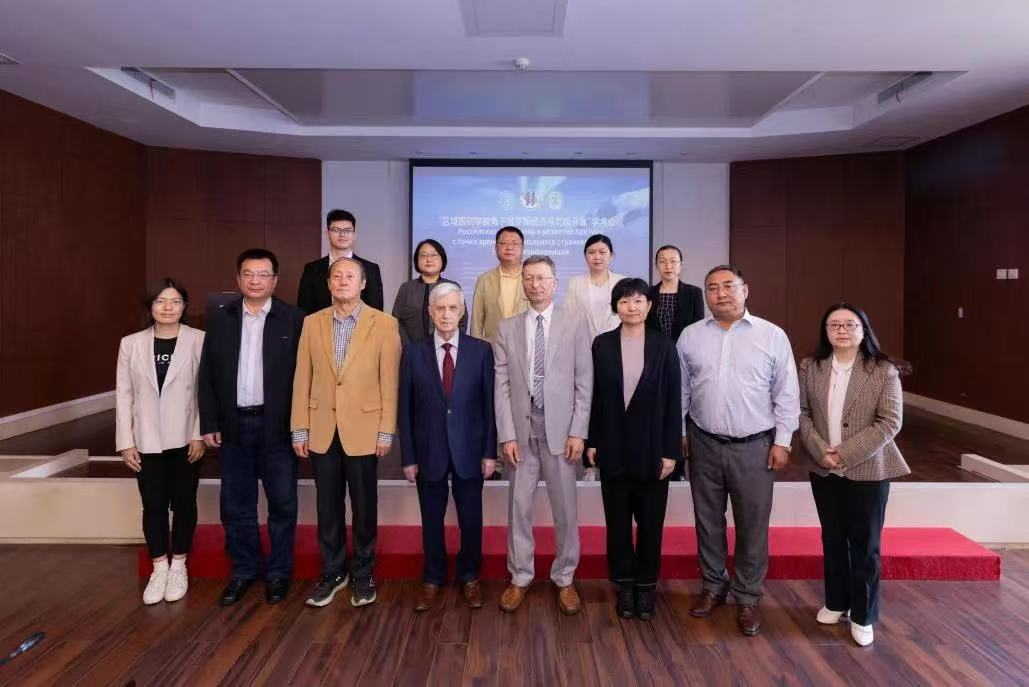
On May 27, 2025, the academic conference titled "Russian Economy and Arctic Development from the Perspective of Regional and Country Studies" was successfully held at Jilin University. The event was jointly organized by the Northeast Asian Research Center, the Arctic Research Institute, and the Sino-Russian Regional Cooperation Research Center of Jilin University, and co-sponsored by the Jilin Provincial Society for Russian, Eastern European and Central Asian Studies. Against the backdrop of President Xi Jinping's state visit to Russia on May 7, 2025, which further deepened the China-Russia Comprehensive Strategic Cooperative Partnership for a New Era, the conference focused on key issues in Sino-Russian cooperation. Nearly 20 experts and scholars from institutions including the Siberian Branch of the Russian Academy of Sciences, the Financial University under the Government of the Russian Federation, Jilin University, Northeast Normal University, Jilin Provincial Academy of Social Sciences, Heilongjiang Provincial Academy of Social Sciences, and Guangdong University of Foreign Studies attended the meeting.
The first session, "Russian Far East and Arctic Development," was chaired by Professor Zhu Xianping, Professor of the Sino-Russian Regional Cooperation Research Center, Honorary Doctor of the Russian Academy of Sciences, and Academician of the Russian Military Academy. Professor Selifastov Vyacheslav, Director of the Center for Strategic Analysis and Planning and the International Scientific Center for Eurasian Cross-Border Interaction Issues at the Institute of Economics and Industrial Production Organization of the Siberian Branch of the Russian Academy of Sciences, reported on the development prospects of the Russian Far East and Siberia. Professor Tokarev Anatoly, Director of the Resource Economics Center at the Institute of Economics and Industrial Engineering of the Siberian Branch of the Russian Academy of Sciences, and Academician Valery Kryukov, Director of the Institute, delivered a joint report analyzing the challenges, threats and opportunities in oil and gas resource development in the Arctic. As the largest regional branch of the Russian Academy of Sciences, the Siberian Branch oversees 9 scientific centers and 104 research institutes. The Russian delegation, led by Academician Valery Anatolyevich Kryukov, has long been engaged in research on resources, environment, transportation and other issues in the Russian Far East and Arctic, enjoying a high academic reputation at home and abroad. Chinese speakers in the first session included Professor Li Tianzi, Director of the Arctic Research Institute of Jilin University, and Researcher Zhong Jianping, Director of the Russian Studies Institute of Heilongjiang Provincial Academy of Social Sciences, who analyzed the problems facing Sino-Russian cooperation in the new context from the perspectives of the Far East and the Arctic respectively. Ming Sheng, Director of the Eurasia Division of the Foreign Affairs Office of Jilin Provincial People's Government, introduced the latest progress of Jilin Province's participation in the development and cooperation of the Russian Far East and Arctic, and looked forward to the province's role in future Sino-Russian cooperation.
The second session, "Russian Economy and International Cooperation from the Perspective of Regional and Country Studies," was chaired by Researcher Xuefeng Yang, Director of the Russian Studies Institute of Jilin Provincial Academy of Social Sciences. Professor Marina from the Financial University under the Government of the Russian Federation and Professor Natalia, a foreign teacher at the School of Northeast Asian Studies of Jilin University, respectively introduced Russia's cooperation with Global South countries and Russia's foreign trade under sanctions. Associate Professor Li Xiaoling, Director of the Research Center for Russian and Arctic Regional Cooperation of Northeast Normal University, analyzed changes in Heilongjiang Province's investment pattern in the Far East based on the polarization trend of Russia's spatial development. Associate Professors Xuan Chunji and Li Hongmei from the Northeast Asian Research Center respectively presented on inter-Korean cooperation with Russia and Japan's Arctic policy trends amid U.S.-Russia competition, giving full play to the disciplinary advantages of the Northeast Asian Research Center in regional and country studies of Northeast Asia and broadening the research horizons of participating experts.
Finally, Professor Li Tianzi, Director of the Arctic Research Institute and the Northeast Asian Research Center of Jilin University, concluded the conference. She noted that the meeting focused on practical issues in current Sino-Russian economic cooperation and Arctic development, with in-depth exchanges between Chinese and Russian scholars on topics of mutual interest. The conference provides important references for promoting pragmatic cooperation between the two countries, further deepening the comprehensive strategic cooperative partnership for a new era, and advancing peace and development in Northeast Asia.